The Folklore Faces (2021-2022)
Millennials' old societal memories revive through the personal reminiscence of their practitioners.
Subrata Ghosh's debut essay collection Khapa Khuje Fere (2018) was an endeavour to rediscover Bengal's local history and socio-religious customs from the perspective of a 21st-century cultural aficionado.
His upcoming publication Dekha Sakshat (2023) is a conversational testimony that manifests a phenomenon where folk practices dilute into the individual identity of their practitioners only to get rejuvenated together.
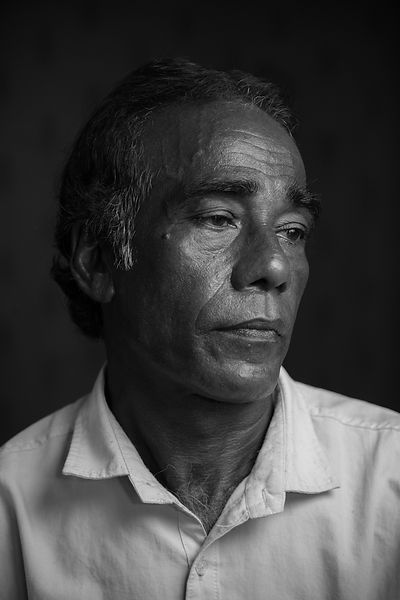
The artists and artisans I have photographed were not superhumans but commoners who went the extra mile to embrace their creative pursuits defying the chronic clutch of poverty.
Dekha Sakshat celebrates the eternal nexus between a creator and her creations, a practitioner and his practices.

Book Cover
Designed by Dibyendu Ghosh
Calligraphy by Santu Karmakar

Subalchandra Das
60. Ramayana Chanter.
Subalchandra Das is a celebrated Ramayana chanter from Panskura, Purba Medinipur.
Though his father was also a traditional practitioner in the field, he became keen from listening to radio programmes. He is known for his distinctive style of performance that carries forward the Bankura Gharana set by iconic chanter Anath Bandhu Adhikary.
Das was featured in broadcast shows, has published albums over decades and now maintains a YouTube channel to reach his audience spread across the region.
Putul Karmakar
50. Dokra Artist
Putul karmakar is a Dokra artist from Bikna Shilpadanga, Bankura. She learned the technique of low-wax casting using non-ferrous metals from her father at an early age. Her ancestral village Dariyapur in Burdwan is famous for this art form.
Karmakar now leads a family of around 30 members defying chronic poverty. Her artistic mastery over paikona and lakshmisaaj— the intricate styles of Dokra has brought her wide acclamation.


Rabindranath Saha
62. Bahurupi
Rabindranath is a traditional Bahurupi from Sainthia, Birbhum. He left home at the age of eight.
The runaway kid was rescued by another Bahurupi at a nearby railway junction. Living under the guardianship of that man for seven years influenced him to come to the practice full-time.
Bahurpis, mainly from the Bedia community of Bengal, put up rustic makeup to play the roles of mythological deities and characters of local folklore in a door-to-door performance.
Shyamal Pramanik
67. Bolaan Artist
Shyamal Pramanik debuted his venture of forming a troop of singers and musicians for Bolaan Gaan in his native village Begunkola, a flood-prone hamlet island of river Ajay in Purba Bardhaman.
Bolan Gaan is a genre of traditional folk songs performed to celebrate the marriage of the Hindu mythical deity Lord Shiva in Chaitra, the concluding month of the Bengali almanac.
Once an active supporter of communism, Shyamal is unique in his lyrics to narrate the everyday struggle of the region's commoners.


Asimkumar Haldar
70. Folk-theatre Playwright
Asim Kumar Haldar is a playwright of folk theatres from Dhaniakhali, Hoogly.
Jatrapaala, the folk theatre, was once a popular source of entertainment in South Bengal. It was performed on an open stage accessible from three sides. This particular form of drama is distinctive in its vibrant dresses, expressive gestures and loud acting styles.
Haldar began his acting career in his community of farmers and agricultural labours, decades ago. At Calcutta Epic Theatre, he further developed his acting skills during his postgraduate studies before reinventing himself as a playwright.
Kalir Kalnemi, Swami Aaj Asami, and Premer Ghaate Noukadubi are a few of his widely performed plays.
Sitanshu Choudhury
68. Artisan of Handloom Bobbin Holder
Sitanshu Choudhury is an artisan of Maaku, the conventional handloom bobbin holder, from Bahirkhand, Hooghly.
Choudhury is the only practising artisan from an ancestry of renowned craftsmen. In Dhaniakhli, Aatpur, Rajbalhat— the hub of the handloom industry of West Bengal— the family was once popular for making maaku bobbins of unparalleled quality.
The introduction of power looms has drastically replaced manual weaving machines and, over time, has reduced the demand for conventional bobbins.


Kshudiram Das
53. Traditional Drummer
Kshudiram Das is a barrel drum player from Samudragarh, Purba Bardhaman.
The last five generations of his ancestry have earned their bread as professional drummers. Das learned the basics of the art of playing a dhola under the continuous mentorship of his father. Later, he worked with Dohar, a prominent folk music band, and received recognition on TV reality shows and radio programmes for his command over the instrument.
Dhol, an ethnic hand drum, is intrinsic to Bengali rituals and performances. Oscar-winning Indian director Satyajit Ray has also celebrated the role of this musical instrument in the region's everyday life in his fantasy film Goopy Gyne Bagha Byne (1969).
Abbas Sekh
50. Satypirer Panchali Chanter
Abbas Sekh is a hereditary ethnic chanter of Satypirer Panchali from Ausgram, Purba Bardhaman. At the Bawaman Shah's Dargah, located in his own neighbourhood, Sekh debuted his career. Currently, he performs at least 120 show nights a year.
His musical pursuit promotes the religious stream that idealises a non-sectarian worship practice, prevalent in Bengal. Badhshahi Paala, Shahidi Karbala, and Hasan Hussein's Tale are some of his popular performances.
Satyapirer Panchali, also known as Ekdali Gaan, was introduced in the medieval period. The introduction of Islam in Bengal gave birth to a literary series that glorified the life and deeds of Satya Pir, a deity praised by both Hindus and Muslims of the region.
This article contains informational inputs from Subrata Ghosh and Banglapedia.org.